

For federal capture teams
Silas™
Wake up to six leads you can attack, not six hundred you have to rule out.
Silas is the whole pursuit, not a tool you paste things into.
Hands-on engagement, not a self-serve sign-up. Access is granted by request.
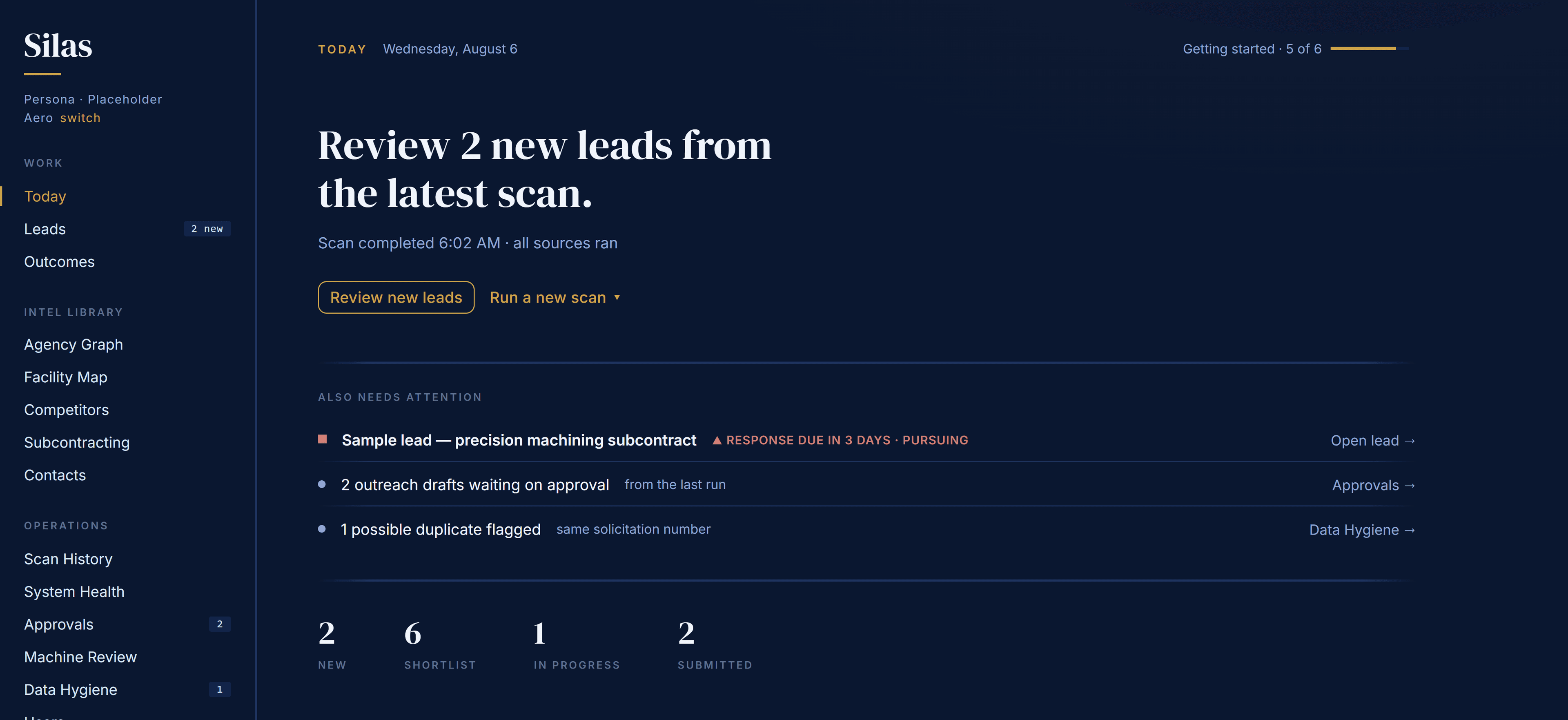
Oftenthe federal sources swept while you sleep
Rankedevery notice scored against your capability profile
One queuethe same solicitation posted in three places arrives once
On the recordwhat scored what, who overrode it, and why you passed
What is Silas?
Federal bid-pipeline software from Vortex Computation™. One system, from finding the opportunity to filing the response.
- Sweeps the federal opportunity sources, often.
- Reads each solicitation for what it obligates you to.
- Scores fit against your company profile.
- Produces a compliance matrix.
- Drafts the response.
- Two real limits, written here rather than found on a demo call.
- Federal only.
- An engagement, not a subscription. No signup, no billing.
Most of the federal market is not your problem.
The job is not to see everything posted. It is to see the few you are actually positioned to win, with the reasoning attached.
- Postedeverything
- Plausiblea fraction
- Worth your bid teama handful
Illustrative. Actual proportions depend entirely on your capability profile and the week.
The pursuit, end to end
Your team spends the week deciding, not retyping.
Find
The work you can actually win
The pursuits that fit how you are positioned. Not everything posted, and not a saved search you end up ignoring by Thursday.
Read
What the solicitation demands of you
Set-asides, clearances, location, past-performance bars. A disqualifier surfaces before your team has spent a week on it.
Draft
A response that starts from something
A first draft lands with the dossier. The week goes on deciding and sharpening, not finding and retyping.
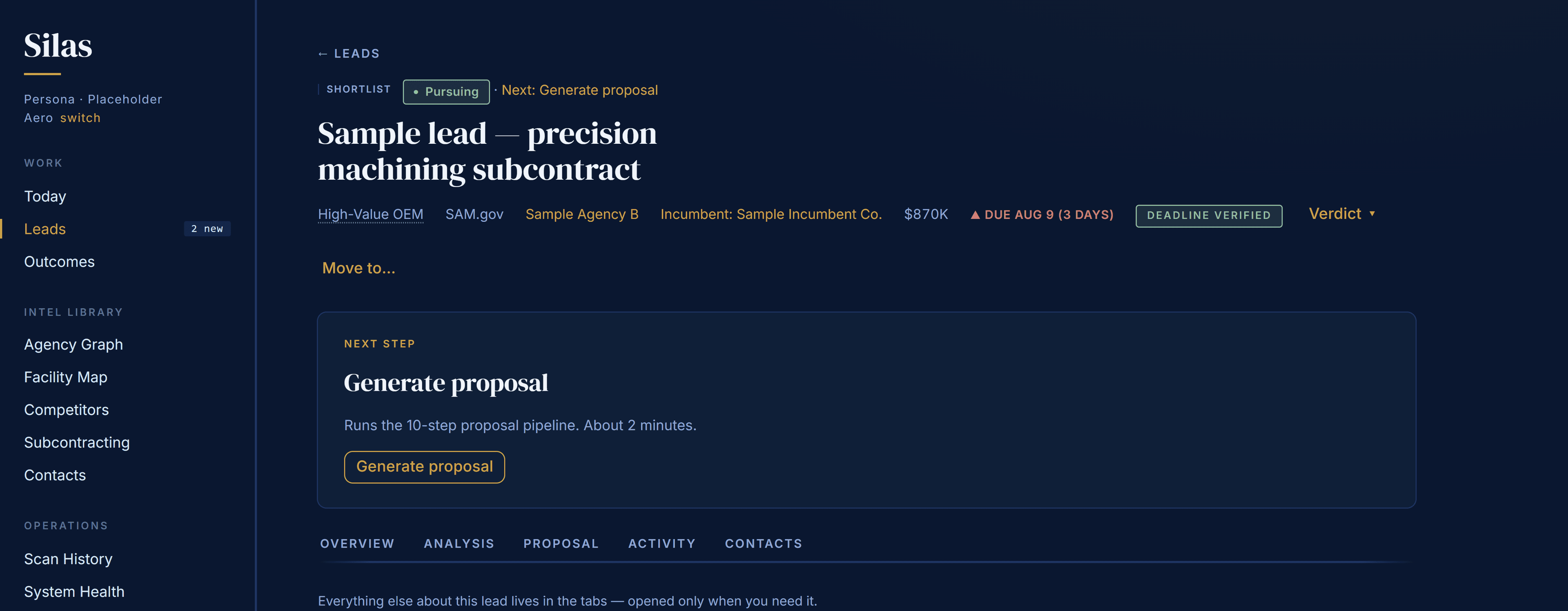
A recommendation you can argue with, and a record you can produce.
Go / no-go
A bid recommendation you can argue with.
A score you cannot interrogate is not a decision. It is a guess with a number on it.
Every recommendation shows its reasoning: the fit it saw, the risk it weighed, and where you fall short.
So a capture lead can disagree on the specifics instead of taking it on faith.
Audit trail
Six months later, the question still has an answer.
When a debrief asks why that pursuit went the way it did, the answer is retrievable rather than remembered.
What scored what, who overrode it, and why you passed, kept on the record. A human’s decision is protected from being quietly reverted by the next run.
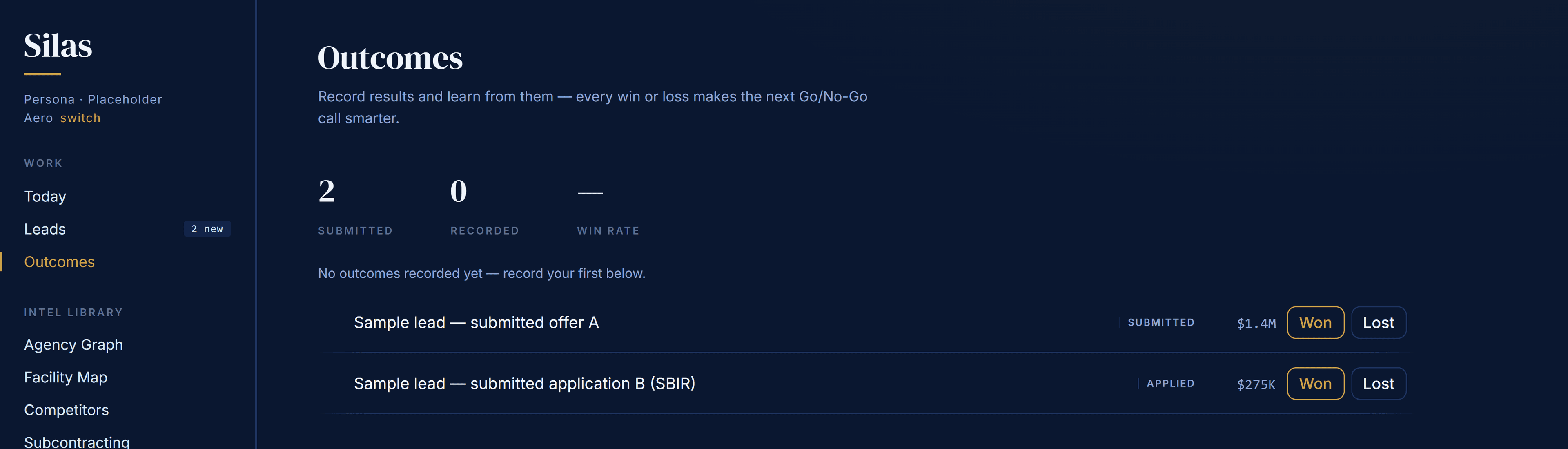
Coverage
Which government sources does Silas cover?
Federal only. Five source families, swept often.
- Contract opportunities
- Defense logistics solicitations
- Grant announcements
- Small-business innovation topics
- Historical federal award and spending data
Deduplicated into one queue, so the same solicitation posted in three places arrives once with every link attached. No state, local, education or Canadian coverage None, not partial, not in beta. If a single state or county solicitation matters to you, a broader tool is the right buy and we will tell you which one. See the honest comparisons.
It refuses controlled material. Deliberately.
Silas uses AI models to read and draft. That is exactly why it is built to refuse controlled material: never put CUI, classified, or export-controlled content into it.
Your data is encrypted at rest, and your pursuit information stays yours.
Silas is working on this capability, but cannot directly help you with controlled material today. If you would like to be notified when we release it, tell us.
Notify me when this shipsThe reference behind the answers.
18
federal contracting terms, defined
15
cited to FAR, CFR or equivalent authority
3
scored quizzes
Each definition links to the pages and quizzes that use it, so a term you meet once is reachable from everywhere it matters. Read the glossary.
Common questions
- What is Silas?
AnswerHide
Federal bid-pipeline software. It finds the work, reads it, scores your fit, and drafts the response.
Silas is federal bid-pipeline software from Vortex Computation. It sweeps the federal opportunity sources often, reads each solicitation for the obligations it places on the bidder, scores fit against your company profile, produces a compliance matrix, and drafts the response. One system covering opportunity identification through proposal operations, rather than a search tool you paste findings out of.
- Which government sources does Silas cover?
AnswerHide
Federal only. No state, local, education or Canadian coverage. None, not partial.
Federal only. Contract opportunities, defense logistics solicitations, grant announcements, small-business innovation topics, and historical federal award and spending data. Silas has no state, local or education (SLED) coverage and no Canadian coverage. None, not partial. If a single state or county solicitation matters to you, Silas cannot see it and a broader tool can.
- How much does Silas cost?
AnswerHide
There is no published price. Silas is delivered as an engagement, so scope sets the number.
There is no published price today, because Silas is delivered as an engagement rather than as a self-serve subscription. There is no signup and no billing. What a price would be set against is scope: how many opportunity lanes you track, how much of the proposal workload moves into the system, and how much profile setup your company needs first.
- Can Silas handle CUI or classified material?
AnswerHide
No, and it is built to refuse it.
No, and it is built to refuse it. Silas uses AI models to read and draft, which is exactly why controlled unclassified information, classified material and export-controlled content must never be put into it. Silas is working on this capability, but cannot directly help you with controlled material today. If you would like to be notified when we release it, tell us and we will.
- Is Silas a trained AI model?
AnswerHide
No. Silas is the guardrails around the models, not a model.
No, Silas is not a trained model. It is methodology: guardrails, checks and bounds around AI models that do the reading and the drafting. Silas is not trained on customer or government data. What Silas adds is the layer around the model: eligibility checked against the set-aside actually named in the notice, a deterministic compliance matrix against your real profile, and a durable record of why each judgement was made.
- Is Silas the same thing as a solicitation search engine?
AnswerHide
No. A search engine stops when the solicitation is found. Silas starts there.
No. A search engine ends when the solicitation is found. Silas is built for what happens next: the bid/no-bid call with its reasoning attached, a deterministic compliance matrix against your real profile, a draft that refuses to state what it cannot support, and a durable record of every decision. Breadth of search is not what it competes on.
More detail: what GovCon capture tooling costs, how Silas compares to the alternatives, and the federal contracting glossary.
Tell us what you chase, and we'll show you what you missed.
Access is granted by request, so the first conversation is a real one.
What you pursue, how you qualify it, and whether Silas would actually change your week.
Request access via Vortex Computation